The Gen 1 Post-Mortem: What Actually Failed
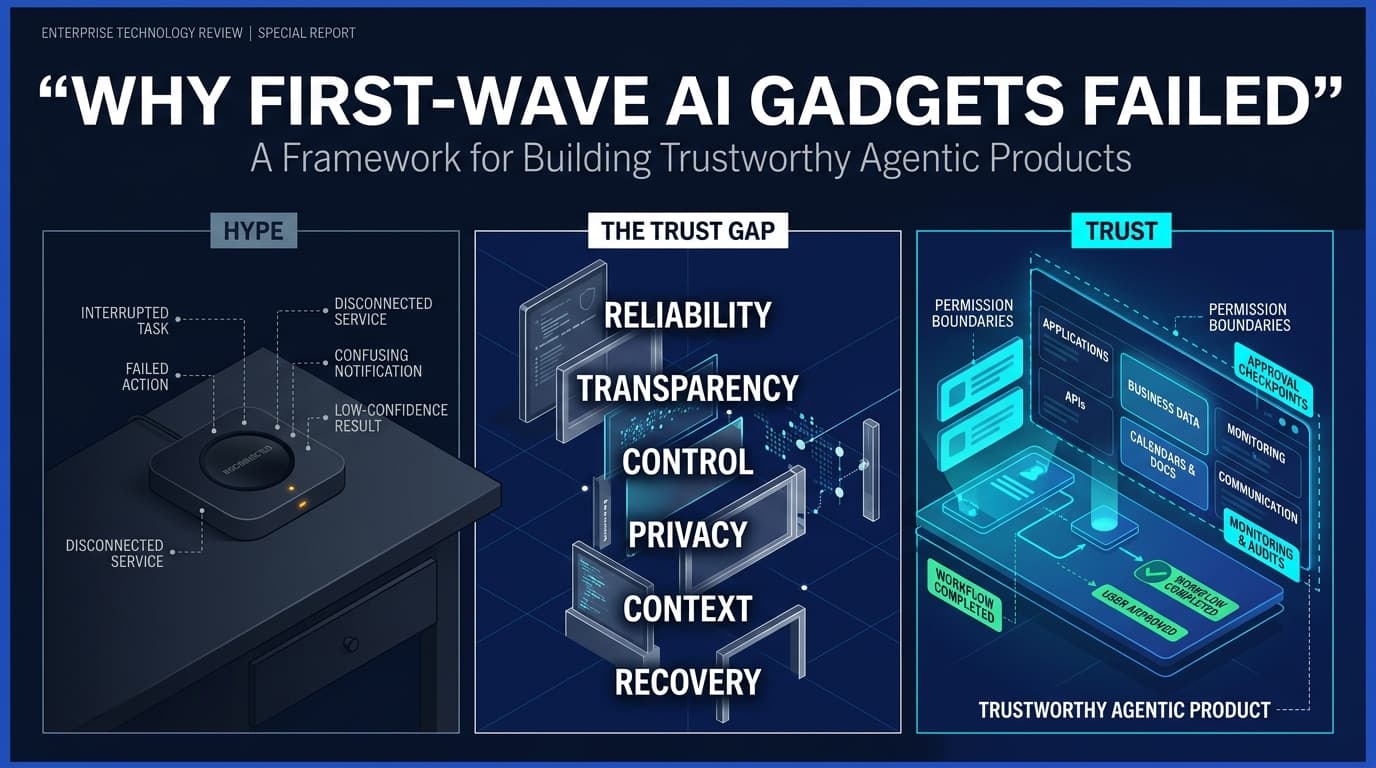
Tony Fadell's MIT Future Fest slide showed three discontinued devices — Rabbit R1, Humane Ai Pin, Limitless pendant — each launched with assistant metaphors and each dead within a generation. His diagnosis: "interesting technology for geeks" that articulated no user pain. The assistant metaphor assumes mental models most users don't possess; Fadell notes <0.01% of the world population has ever had a human assistant, so "we want an assistant" is a framing by people who have assistants, for people who don't know what one does.
The devices shared a pattern: demo-ware that worked in controlled settings but collapsed on recurring real-world workflows. Rabbit's Large Action Model promised app automation but stumbled on authentication flows. Humane's projector interface required precise hand positioning that failed in sunlight. Limitless recorded everything but offered no retrieval paradigm beyond search. None solved a high-frequency, high-value problem that justified the hardware tax.
Trust Is Staged, Not Granted: The Assistant Onboarding Gap
Fadell's personal-assistant analogy maps directly to agentic system design. A human assistant earns bank access over years — not day one. Agentic products must mirror this gradient: progressive permission scopes, audit trails, and reversible actions before autonomous execution.
The Meta Muse vulnerability illustrates the collapse when trust staging is skipped. A security researcher found a serious flaw post-launch; 404 Media reported Meta employees discovered issues prompting a "mad dash" to fix problems before launch. The vulnerability allowed VM escape — a fundamental isolation failure. In agentic terms: the system was granted broad execution scope without the incremental verification that human trust-building requires.
Design implication: every agentic capability needs a trust budget. Start with read-only observation, add suggested actions with explicit confirmation, then graduated autonomy with rollback. Log every decision point. Make the permission model visible and revisable — not a one-time OAuth dialog.
On-Device Architecture as Trust Infrastructure
Fadell's on-device mandate isn't privacy theater — it's architectural necessity. Local-first inference eliminates round-trip latency for interactive agents and keeps sensitive context (calendar, contacts, financial data) off network paths. Apple's Face ID precedent proves the model: biometric data never leaves the Secure Enclave, earning user consent for the most sensitive credential.
The trade-off is model size vs. capability. Distillation and quantization shrink frontier models to device-scale; RAG retrieval keeps knowledge current without retraining. The architecture pattern: small on-device model handles routing, intent classification, and low-stakes actions; cloud fallback only for heavy reasoning on non-sensitive data. This matches the trust gradient — high-stakes decisions stay local.
Our agentic AI systems we ship implement this split: local Llama-class models for planning and tool selection, cloud calls scoped to specific non-PII workloads.
Sensor Access Without the Hardware Tax
Meta and OpenAI are building gadgets because they lack sensor access on iOS/Android. Each permission prompt — camera, microphone, location, contacts, calendar — is a trust tax. Twenty prompts before first value is UX death spiral.
The software alternative: compose existing phone sensors via OS-level intents. iOS App Intents and Android's App Actions let agents request scoped capabilities ("read next meeting," "scan receipt") without blanket permissions. The agent declares its capability needs in a manifest; the OS mediates with user consent per capability. No new hardware, no Bluetooth pairing, no 5G fallback.
This shifts the bottleneck from hardware distribution to platform cooperation — but platforms have incentive to enable useful agents that increase ecosystem stickiness.
Pain-First Discovery: Replacing Demo-Driven Development
Fadell's "understand what pain you're solving" operationalizes as a pre-build validation loop. Distinguish "neat demo" from "recurring high-value workflow" by running a founder-led concierge MVP: manually execute the target workflow for 10-20 users, instrumenting every step. Measure task completion rate, error recovery frequency, user-initiated re-engagement. Only automate the steps that survive this filter.
This mirrors human-assistant trust building. The concierge phase is the "first couple of years" Fadell describes — learning the user's context, exceptions, and implicit preferences before any code ships. The agentic system then codifies the observed patterns, not imagined ones.
Our AI automation workflow design engagements start here: concierge observation, then n8n/Make prototypes, then agentic hardening.
The One-Shot Constraint: Startup vs. Platform Risk Profiles
Fadell's "startups get one shot" contrasts with Apple's Vision Pro latitude. A failed agentic launch burns the company; Apple can iterate publicly. This dictates roadmap scope: first release targets a single, high-trust, high-value workflow — invoice reconciliation, code review triage, prior-authorization drafting. Defer general-purpose "assistant" branding until trust capital is earned.
Portfolio approach: ship narrow agents that compound into a platform. Each agent pays for the next by solving a complete workflow end-to-end. The platform emerges from shared infrastructure (auth, audit, memory, tool registry), not from a master agent that does everything poorly.
Checklist: Four Gates Before Shipping an Agentic Product
Synthesizing the framework into a go/no-go decision tool for product and engineering leads:
| Gate | Criterion | Evidence Required |
|---|---|---|
| 1. Pain Articulation | Can target users describe the problem without AI terminology? | Verbatim user quotes from concierge sessions; workflow frequency & cost data |
| 2. Trust Staging | Does the permission model map to a human-assistant onboarding timeline? | Progressive scope diagram; audit log schema; rollback test results |
| 3. Data Gravity | Can core inference run on-device with cloud fallback only for non-sensitive heavy lift? | Model size vs. device target benchmarks; data classification matrix; latency SLOs |
| 4. Sensor Strategy | Does the product leverage existing device sensors without new hardware? | Capability manifest; OS intent mappings; permission prompt count < 5 |
Fail any gate → narrow scope or redo discovery. Ship only when all four pass.
Frequently Asked Questions
How do I know if my agentic idea is a "neat demo" vs. real pain?
Run a concierge MVP: manually perform the workflow for paying users for 2-4 weeks. If they re-engage unprompted and describe the problem in their own words without mentioning AI, it's real pain. If they only engage when you prompt them, it's a demo.
Can't I just use cloud inference and encrypt everything?
Encryption in transit doesn't solve the trust gradient. Users (and compliance regimes) treat cloud-processed PII differently than on-device processing. The Meta Muse vulnerability exploited cloud-side isolation — a risk class that disappears when sensitive inference stays local. On-device also removes latency variance that breaks interactive agent UX.
What if my workflow needs sensors the OS doesn't expose via intents?
That's the hardware tax trap. First, verify the gap: many "missing" sensors (document scanning, barcode, NFC tag) already have App Intent coverage. If a genuine gap remains, scope the agent to workflows that don't need it — or partner with a hardware maker who already has distribution, rather than building your own device.
Audit your agentic roadmap against the four gates — book a 30-min architecture review with our team.